Is Aquamation ash safe to handle?

Aquamación es un método de disposición final que está disponible tanto para nuestros seres queridos humanos como para nuestras mascotas. El nombre científico de este proceso a base de agua es hidrólisis alcalina. Es el mismo proceso que ocurre como parte del curso natural cuando un cuerpo se deposita en la tierra. Se utiliza una combinación de flujo de agua suave, temperatura y alcalinidad para acelerar la descomposición de los materiales orgánicos.
La aquamación para mascotas está aprobada en todos los Estados Unidos y Canadá. La aquamación para humanos está aprobada en 21 estados, 4 provincias y otras partes del mundo.
The Aquamation process is performed after any viewing or visitation services the family wishes to have. When it’s time for the process, the individual body is respectfully placed in a stainless steel vessel. Alkali is added to the process based on individual characteristics (weight, sex, embalming status), and the vessel fills with water. The solution of 95% water and 5% alkali is heated to 200-300°F, and gently circulated for the entire length of the process.
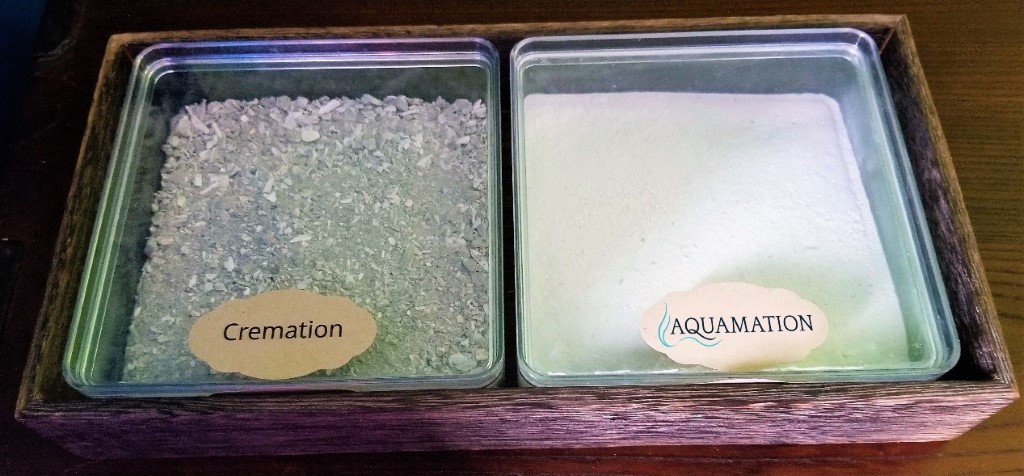
Al final del proceso, todo el material se descompone en sus componentes más básicos; no queda rastro alguno de ADN ni ARN. El agua de proceso, que es estéril, se vierte para su reciclaje (nuestros cuerpos están compuestos, en un 65 % aproximadamente, por agua), y la cámara realiza un enjuague con agua limpia del equipo y de los restos. Cuando el operador abre la puerta, solo quedan los minerales óseos inorgánicos. Estos minerales se procesan hasta convertirlos en polvo y se devuelven a la familia en una urna. Este paso final del procesamiento es el mismo que se sigue en la cremación con llama. Muchas familias celebran una ceremonia conmemorativa o una reunión cuando los restos del ser querido son devueltos al cuidado de la familia.
El proceso de cremación por llama ocurre a 1600-1800 °F con los restos en contacto directo con la llama. Algunos de los restos minerales inorgánicos se pierden al aire a través de la chimenea. Los Aquamación El proceso ocurre a 200-300°F sin cualquier fuego, y la circulación de agua en el sistema es un flujo similar al de un arroyo o riachuelo. Es muy suave con los restos minerales finales, lo que permite que haya más ceniza al final del proceso.
The ash remains are 100% safe to handle. Alkaline hydrolysis is a proven sterilization process that results in pathogen and disease free remains.
As with anything, toxicity of a substance is a function of concentration. Miracle grow is a fertilizer, but if over-applied, it can kill a plant. A daily multivitamin is not toxic when taken as directed, but it would be toxic (and likely deadly) if the whole bottle were to be taken. When spreading or scattering ashes, we need to pay mind to where we are scattering them. A cremation garden that allows the scattering of ashes from hundreds of individuals can be a tough environment for growing plants. In extreme cases, poor practices could result in contamination of the water table. For families wanting to use the ashes from Aquamación or flame cremation as part of a potting soil, allowing their loved one to live on through the plant, the ashes are certainly not toxic if the soil is properly prepared. Significantly diluting the calcium phosphate ashes with potting soil and a pH balancer to match your region and specific plant type makes the ashes beneficial to the plant instead of potentially toxic. Your Aquamación el proveedor puede brindarte orientación para crear tu memorial en vida.
Please check local regulations to make sure the scattering location is okay prior to scattering, and speak with your funeral professional about the best way to scatter the ashes so your experience can be as meaningful as possible. Funeral professionals have great tips for making the scattering experience go as expected. Some special care must be taken when spreading the ashes in wind or water, as the ash is quite fine. Your Aquamación el proveedor te proporcionará orientación.
– Mitch